
There’s nothing quite like curling up by a warm fire on a cool Florida evening, until you notice water dripping down your chimney or stains spreading across your ceiling. If you’re a homeowner in Largo dealing with chimney leaks, you’re far from alone. Our subtropical climate, with its intense summer storms and year-round humidity, creates the perfect conditions for water infiltration that can turn a minor issue into a major headache.
At A Sweep Across The Bay, we’ve spent over 44 years helping homeowners throughout the Tampa Bay area protect their chimneys from water damage. We’ve seen firsthand how quickly a small leak can escalate into costly repairs, crumbling masonry, rusted dampers, damaged flue liners, and even structural problems that threaten your home’s safety. The good news? Professional chimney waterproofing works, and when done right, it can save you thousands in repairs while extending your chimney‘s lifespan for decades.
In this guide, we’ll walk you through everything you need to know about stopping chimney leaks in Largo: why our local weather is so tough on chimneys, the warning signs you shouldn’t ignore, and the professional waterproofing solutions that actually deliver lasting protection.
Why Chimneys in Largo Are Prone to Water Damage
Living in Largo means dealing with weather patterns that are uniquely harsh on masonry structures. We’re not just talking about the occasional rainstorm, we’re talking about a climate that seems almost designed to test your chimney’s defenses.
First, there’s the sheer volume of rainfall. Largo and the broader Tampa Bay area receive an average of 50+ inches of rain annually, much of it concentrated during our intense summer storm season. These aren’t gentle showers: they’re often driving rains accompanied by strong winds that push water sideways into every crack and crevice. Your chimney, standing above your roofline and exposed on all sides, takes the brunt of this assault.
Then there’s the humidity factor. Even on days without rain, our air is saturated with moisture. This constant humidity prevents masonry from fully drying out between storms, which accelerates deterioration. Bricks and mortar are porous materials, they absorb water like a sponge. When that moisture never fully evaporates, it creates a perpetual cycle of saturation that weakens the structure from within.
The temperature fluctuations we experience, while milder than northern climates, still contribute to the problem. Cool nights following hot days cause expansion and contraction in masonry materials. Over time, this thermal cycling creates tiny cracks that grow larger with each passing season. And unlike homes up north where chimneys see regular use during winter months (which actually helps dry them out), many Largo chimneys sit unused for extended periods, allowing moisture problems to develop unchecked.
Salt air from the Gulf adds another layer of complexity. If you’re within a few miles of the coast, airborne salt particles settle on your chimney and accelerate the deterioration of mortar joints. We’ve inspected chimneys in coastal Largo neighborhoods that showed decades worth of damage after just a few years of exposure.
At A Sweep Across The Bay, we excel at identifying these issues and determining the right course of action for our customers. Understanding why Largo chimneys are so vulnerable is the first step toward protecting yours.
Common Signs Your Chimney Has a Leak
Chimney leaks rarely announce themselves with a dramatic waterfall pouring into your living room. More often, they’re subtle, showing up as small signs that are easy to dismiss until the damage becomes severe. Here’s what to watch for, both inside and outside your home.
Interior Warning Signs
The most obvious interior sign is water in your firebox. If you notice puddles or dampness on your firebox floor after a rainstorm, water is definitely getting in somewhere. But by the time water reaches the firebox, it’s often traveled a long path through your chimney system, potentially causing damage along the way.
Staining on walls or ceilings near your chimney is another red flag. These stains might appear brown, yellow, or rust-colored, and they often grow larger over time. Don’t make the mistake of just painting over them, that’s treating the symptom, not the disease. The moisture causing those stains is also promoting mold growth inside your walls.
Speaking of mold, a musty odor coming from your fireplace area, especially during or after rain, suggests moisture is accumulating somewhere it shouldn’t. This is more than an aesthetic concern: mold can create serious health issues for your family.
Rust on your damper or firebox is telling you that water has been present long enough to corrode metal components. A rusted damper won’t seal properly, leading to energy loss and further moisture problems. We’ve seen dampers so corroded they became completely inoperable.
Peeling wallpaper or bubbling paint near your chimney indicates moisture is migrating through masonry and into your interior walls. If you’re noticing this, the leak has likely been ongoing for some time.
Exterior Damage Indicators
Outside, deteriorating mortar joints are a major warning sign. Look for mortar that appears crumbly, cracked, or recessed between bricks. Healthy mortar should be flush with the brick surface and show no visible cracks. Damaged mortar joints allow water direct entry into your chimney‘s structure.
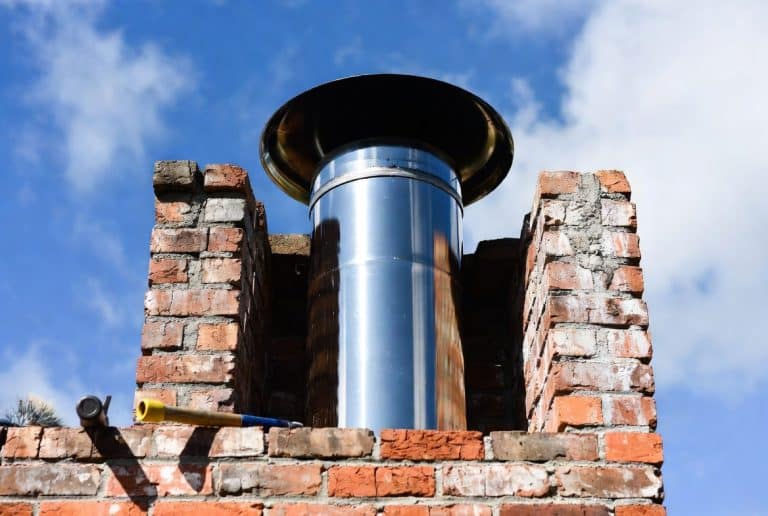
A damaged or missing chimney cap leaves your flue wide open to the elements. Without this protective cover, rain falls straight down into your chimney, soaking everything from the flue tiles to the smoke shelf to the damper. We can’t count how many leak problems we’ve solved simply by installing a proper chimney cap.
Cracks in your chimney crown, that’s the cement covering on top of your chimney, create pathways for water infiltration. Even hairline cracks allow moisture to penetrate, and once water gets into the crown, freeze-thaw cycles (yes, we do get them occasionally) and thermal expansion make those cracks progressively worse.
Flashing problems are among the most common leak sources we encounter. Chimney flashing is the metal barrier that seals the joint where your chimney meets your roof. If this flashing has pulled away, rusted through, or was improperly installed during a roof replacement, water can pour into your home every time it rains. Sometimes the damage from bad flashing shows up in your attic before you notice it anywhere else.
White staining on exterior bricks, called efflorescence, indicates that water is moving through your masonry and depositing mineral salts on the surface as it evaporates. It’s essentially your chimney telling you it has a moisture problem.
How Professional Chimney Waterproofing Works
Effective chimney waterproofing isn’t about slapping some sealant on bricks and calling it a day. It’s a systematic process that addresses existing damage before creating a protective barrier against future moisture intrusion. Here’s how we approach it at A Sweep Across The Bay.
Inspection and Assessment
Every waterproofing project begins with a comprehensive inspection. We need to understand exactly what we’re dealing with before we can fix it, otherwise, we’d just be sealing water inside your chimney along with whatever damage it’s already caused.
Our technicians start with a visual examination of your entire chimney system, from the crown down to the firebox. We’re looking for cracks, deteriorated mortar, damaged flashing, missing or broken chimney caps, and any signs that a chimney liner may be cracked or missing. A damaged liner doesn’t just create moisture problems: it can allow dangerous combustion gases to leak into your home.
Depending on what we find, we may recommend a Level I, II, or III inspection. A Level I inspection covers accessible areas and is appropriate for chimneys that have been regularly maintained. Level II inspections involve more thorough examination, including accessible attic spaces and crawl spaces, and are recommended after any changes to the system or if we suspect hidden damage. Level III inspections are reserved for serious situations where concealed damage is suspected and may require removing portions of the chimney structure.
We’ll also assess the overall condition of your masonry. If bricks are spalling (flaking apart) or mortar joints are severely deteriorated, waterproofing alone won’t solve the problem. These issues need to be repaired first.
Repair and Sealant Application
Once we’ve identified all the issues, repairs come before waterproofing. This might include:
- Tuckpointing: Removing damaged mortar and replacing it with fresh mortar matched to your chimney’s original composition
- Crown repair or replacement: Fixing cracks or rebuilding a deteriorated crown with proper materials and slope for water drainage
- Flashing repair: Resealing or replacing chimney flashing to create a watertight barrier at the roof junction
- Cap installation: Adding or replacing a chimney cap to keep rain, debris, and animals out of your flue
- Liner repair: Addressing any cracks or gaps in your chimney liner that could allow moisture penetration
Only after all necessary repairs are completed do we apply waterproofing sealant. Professional-grade chimney waterproofing products are designed specifically for masonry, they penetrate the surface and bond with the material rather than just sitting on top. Critically, they’re vapor-permeable, meaning they keep liquid water out while allowing water vapor to escape. This is essential because chimneys need to breathe: trapping moisture inside would actually accelerate deterioration.
Application requires clean, dry masonry, so we’ll schedule the work during an appropriate weather window. The sealant is typically applied with low-pressure sprayers to ensure thorough, even coverage. Multiple coats may be necessary depending on your chimney’s condition and the product used.
Choosing the Right Waterproofing Products for Florida Weather
Not all waterproofing products are created equal, and what works in drier climates won’t necessarily hold up to Florida’s demanding conditions. Choosing the right product for our environment makes the difference between protection that lasts and protection that fails within a few years.
The most important characteristic for Florida applications is vapor permeability. We’ve seen well-meaning homeowners (and even some inexperienced contractors) apply standard waterproof sealers that trap moisture inside the brick. In our humid climate, that’s a recipe for disaster. Trapped moisture leads to spalling, efflorescence, and accelerated deterioration from the inside out. Professional-grade chimney waterproofers are specifically formulated to be breathable, they create a hydrophobic barrier that repels liquid water while allowing water vapor to pass through.
Siloxane-based and silane-based products are the industry standards for masonry waterproofing. These penetrating sealers absorb into the brick and mortar rather than forming a film on the surface. They don’t change the appearance of your chimney, they allow the masonry to breathe, and they provide excellent protection against wind-driven rain, which is exactly what we deal with during Florida storms.
UV resistance matters more here than in many other regions. Our intense Florida sun breaks down inferior products within a couple of years. Professional-grade waterproofers are formulated to resist UV degradation, maintaining their protective properties for five to ten years or longer depending on exposure and application quality.
We also consider the specific conditions of each chimney. A chimney on the north side of a home that stays shaded and damp may need different treatment than one on the south side that bakes in full sun. Older chimneys with softer, more porous brick may require products with better penetration characteristics.
At A Sweep Across The Bay, we select products based on over four decades of experience with Tampa Bay area chimneys. We know which products perform in our climate and which ones don’t live up to their marketing claims. We’re not going to use a bargain-basement sealer on your chimney just to save a few dollars, we use professional-grade products because they actually work.
Preventive Maintenance Tips for Long-Lasting Protection
Waterproofing gives your chimney excellent protection, but it’s not a set-it-and-forget-it solution. Regular maintenance extends that protection and helps you catch small problems before they become expensive repairs.
Schedule annual inspections. The National Fire Protection Association (NFPA) Code 211 recommends annual inspections of all chimneys, fireplaces, and vents. Even if you don’t use your fireplace often, your chimney is still exposed to weather year-round. An annual inspection catches deterioration early, when repairs are simpler and cheaper. The Chimney Safety Institute of America (CSIA) also strongly suggests an inspection upon the sale or transfer of a property.
Keep your chimney cap in good condition. This simple component does tremendous work protecting your flue from rain, debris, and animals. Check it periodically for damage, rust, or gaps. If you notice birds or other critters showing interest in your chimney, the cap may need attention.
Monitor your chimney crown. Take a look at your crown at least once a year, binoculars work fine from ground level. Look for visible cracks or pieces that have broken away. Crown damage is progressive: small cracks become big cracks that eventually allow significant water infiltration.
Watch your flashing. After major storms or roof work, check that flashing is still properly sealed. Roofing contractors don’t always re-seal chimney flashing correctly after repairs. If you’ve had recent roof work and notice new leaks near your chimney, flashing is the likely culprit.
Address small repairs promptly. A few cracked mortar joints might not seem urgent, but they’re entry points for water. Dealing with minor issues when they appear prevents them from escalating.
Clear debris from around your chimney. Overhanging branches can damage your chimney during storms and deposit organic matter that holds moisture against your masonry. Trim back any branches within several feet of your chimney.
Reapply waterproofing on schedule. Professional waterproofing products typically last five to ten years, depending on exposure and conditions. Don’t wait until you notice leaks to reapply, staying ahead of the maintenance schedule prevents problems from developing.
Use your fireplace appropriately. On cooler days and during cold snaps in the Tampa Bay area, burning a fire is a great way to warm your home. Regular use actually helps dry out your chimney. Just make sure you’re also keeping up with chimney cleaning, the CSIA recommends annual cleaning for homeowners who burn fires regularly during the heating season.
When to Call a Professional for Chimney Leak Repair
Some chimney maintenance tasks are DIY-friendly, keeping your cap clear of debris, for instance, or watching for obvious exterior damage. But chimney leak repair is generally not a do-it-yourself project. Here’s when you need to pick up the phone.
Call immediately if you notice water actively entering your home. When the rain comes and you notice a moisture problem, we can help find the cause of your chimney leak. It tends to be a process of elimination when the problem isn’t obvious. If you notice rainfall coming inside, call us right away to get an inspection scheduled for your fireplace and chimney.
Call when you see visible damage to masonry, crown, or flashing. These components require professional repair to properly seal against water. Improper DIY repairs can actually make problems worse, using the wrong mortar mix, for example, can cause accelerated deterioration of surrounding materials.
Call if you smell musty odors or notice staining. These signs suggest moisture has been accumulating for some time, potentially causing hidden damage. A professional inspection will determine the extent of the problem and the appropriate repairs.
Call before applying any waterproofing products yourself. Waterproofing over existing damage just seals the problems inside your chimney. Professional assessment ensures necessary repairs happen first.
Call if your chimney hasn’t been inspected in over a year. Proactive inspections prevent emergencies. An experienced technician will spot developing issues that aren’t visible to untrained eyes.
Call if you’re buying or selling a home. The CSIA strongly suggests a chimney inspection upon the sale or transfer of property. This protects both buyers and sellers by documenting the chimney’s condition.
At A Sweep Across The Bay, we provide chimney repair services to Largo, Tampa Bay, St. Petersburg, Clearwater, Bradenton, Sarasota, and everywhere in between. Our family-owned business has over 44 years of experience cleaning, repairing, and maintaining chimneys and fireplaces. We aim to provide our residential and commercial customers with complete peace of mind, knowing their chimneys are in safe and proper working order.
We offer a three-level inspection process depending on the issue and provide a complete line of services including chimney repair and restoration, chimney liner installation, chimney sweep services, and waterproofing. When you choose us, we’ll complete a thorough inspection that checks for blockages, signs of animal infestation, and areas leaking water from our frequent rainstorms.
Conclusion
Chimney leaks in Largo aren’t a matter of if, they’re a matter of when. Our climate throws everything it has at your chimney: intense rainfall, relentless humidity, salt air, and punishing sun. Without proper protection, water infiltration will eventually compromise your chimney‘s structure, your home’s safety, and your wallet.
The good news is that professional waterproofing, combined with regular maintenance, provides reliable defense against these forces. Starting with a thorough inspection to identify and repair existing damage, then applying high-quality, breathable sealants designed for Florida conditions, you can stop chimney leaks before they start, or stop existing leaks from getting worse.
Don’t wait until water is dripping into your firebox or stains are spreading across your ceiling. By then, you’re looking at more extensive (and expensive) repairs. Proactive waterproofing and annual inspections keep small issues from becoming big problems.
If you’re dealing with a chimney leak or simply want to protect your chimney before problems develop, A Sweep Across The Bay is here to help. With over 44 years serving homeowners throughout the Tampa Bay area, we have the experience and expertise to keep your chimney dry and your home safe. Getting started is easy, give us a call or complete our short appointment form to schedule your chimney inspection today.
